

AWS for Laravel teams: where complexity actually enters

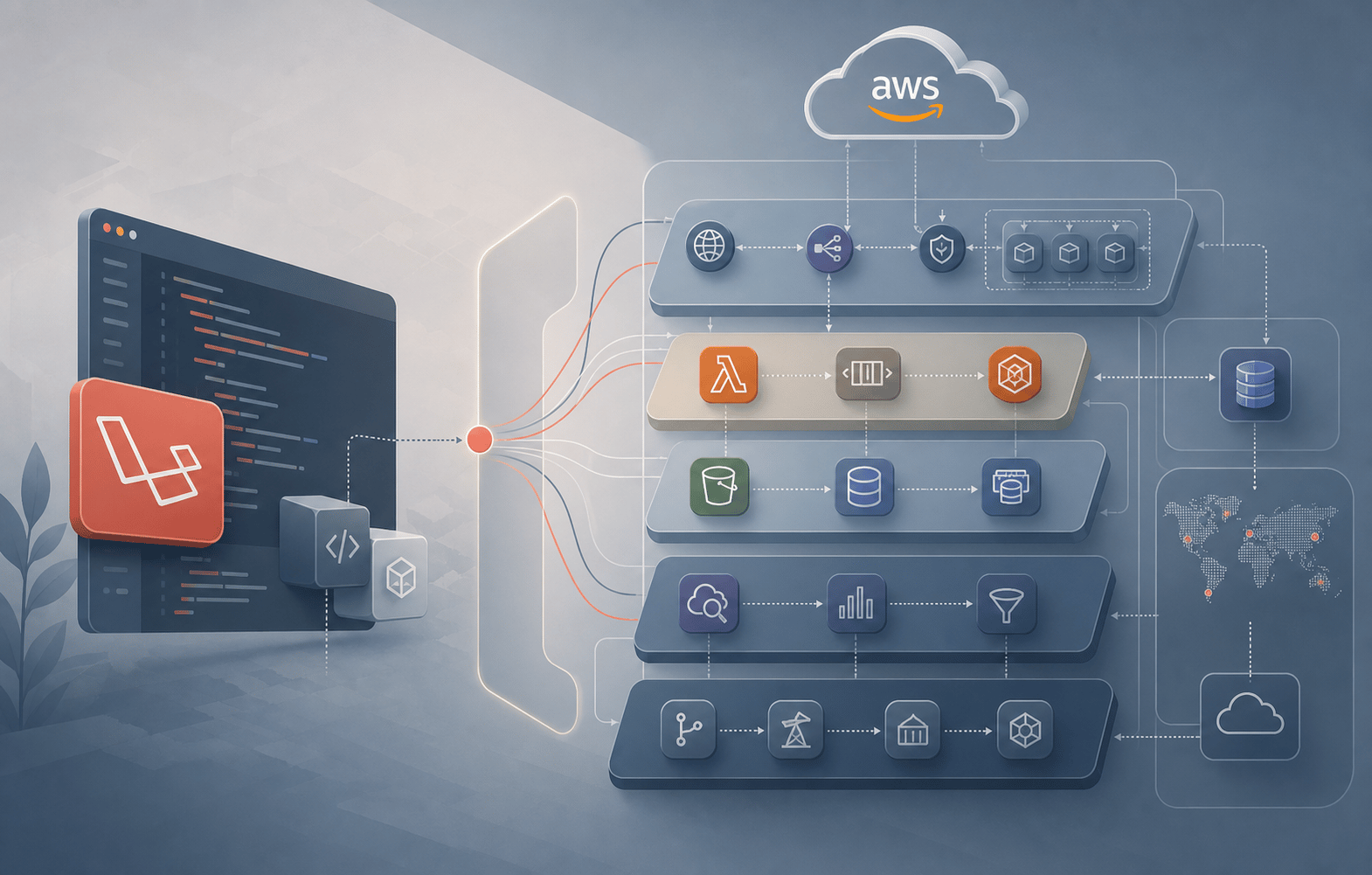
Follow a queued export across IAM, SQS delivery, database capacity, and recovery to expose the operational decisions AWS adds.
Draw the export path before adding services
For a Laravel export feature, the web process accepts a request, a worker reads database rows, the result lands in object storage, and an authorized user downloads it. On AWS, those steps cross identity, network, and failure boundaries. A service diagram should identify the caller and required permission at each edge, not just display product logos.
Start with a small reproducible environment and synthetic data. Separate the web role, worker role, and deployment role when their duties differ. The application should not inherit permission to create or delete infrastructure merely because the deployment system needs it. Prefer workload identities and temporary credentials over embedding long-lived keys in application configuration.
Scope one worker permission explicitly
This identity policy grants an example SQS consumer only the operations needed to receive, acknowledge, inspect, and adjust message visibility on one queue. It assumes the queue URL is already configured. Replace the example account, region, and queue name before evaluation; it is not a complete worker role.
{
  "Version": "2012-10-17",
  "Statement": [
    {
      "Sid": "ConsumeExportJobs",
      "Effect": "Allow",
      "Action": [
        "sqs:ReceiveMessage",
        "sqs:DeleteMessage",
        "sqs:ChangeMessageVisibility",
        "sqs:GetQueueAttributes"
      ],
      "Resource": "arn:aws:sqs:eu-west-1:123456789012:exports-test"
    }
  ]
}
Retry is a normal state, not an exception
SQS standard queues use at-least-once delivery. A job may run again even when the first attempt performed its business effect. Use a stable export identifier and a durable state transition so a second delivery cannot create a second billable operation or expose a partial file. An in-memory flag cannot provide this protection across worker restarts.
Receiving a message temporarily hides it; successful handling must eventually delete it. Set visibility long enough for the processing and acknowledgement path, and arrange the worker timeout so a dead worker does not overlap unnecessarily with a retry. An excessively long visibility timeout also delays recovery after a crash. Laravel’s SQS driver uses the queue’s visibility timeout rather than the Redis-style retry_after setting.
Test the awkward interval: stop a test worker after storing the output but before acknowledging the message. The next attempt must recognize or safely rebuild that output. Configure bounded retries and inspect persistent failures. Distinguish Laravel’s failed-job handling from an SQS dead-letter queue; they are separate mechanisms and their behavior depends on how the consumer fails.
Scaling compute can move the bottleneck
More consumers create more simultaneous database queries, connections, storage requests, and calls to external systems. Cap worker concurrency using the narrowest downstream capacity, then measure backlog age and completion time. An empty CPU chart is not proof that more workers are safe.
Private networking adds another set of checks. A process with correct IAM permissions may still lack a route or endpoint to reach SQS or storage. Conversely, network reachability does not grant permission. Debug connection failures and authorization failures separately, and preserve useful error codes without logging credentials or customer payloads.
Make recovery and cost observable
Record queue depth and age, failed jobs, database pressure, storage growth, and the cost of the chosen network path. Set alerts around user-visible deadlines and actionable failure modes rather than every available metric. Use a synthetic export to prove the whole route after a deployment.
A managed Laravel platform can reduce provisioning work, but your application still owns duplicate handling, authorization, and restore requirements. Before adding another service, name the problem it solves, its operator, and the recovery procedure. If those answers are missing, a larger AWS footprint will mostly add places to investigate.